Concrete Driveway Calculator — ft, yd³, cost
How to use this calculator
Pick a driveway shape — straight rectangle, flared apron (wider at the curb), curved approach, or raw ft² — then set thickness and waste. Optional toggles add a #57 gravel subbase, mesh or rebar, sawcut control joints, and a full $/yd³, $/lf, $/ft² takeoff for the ready-mix order.
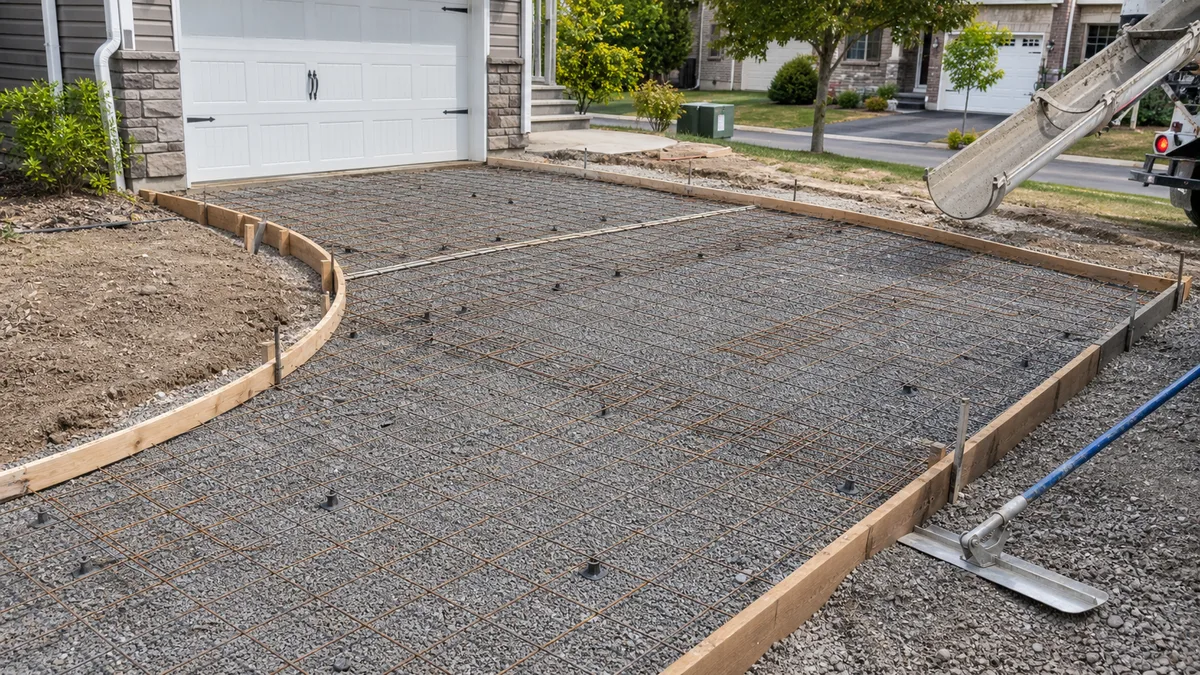
Thickness — 4″ cars only, 5″ standard residential, 6″ for pickups/RVs/contractor traffic. Subbase — 4–6″ compacted #57 stone (IRC §R506.2). Joints — cut at ¼ slab depth within 6–12 hr, spaced ~24–36× thickness. Mix — 4000 psi air-entrained for freeze-thaw climates.
Saved Calculations
| Time | Shape | Area ft² | Concrete yd³ | Gravel yd³ | Joints lf | Total $ |
|---|
Concrete Driveway Estimating Notes
Type the slab length, width and thickness in feet/inches and the page returns yd³ of ready-mix, gravel sub-base tonnage, mesh or #4 rebar counts, sawcut control-joint LF and a $/ft² unit cost — the same line items that go on the supplier order and the homeowner quote. ASTM C94 ready-mix is batched and billed by the yard, so the waste slider plus rounding stops you running short on the last truck. Pour 4″ for cars-only paths, 5″ for the typical residential apron, and 6″ where pickups, RVs or delivery trucks brake and turn; add a thickened edge (turn-down to ~8–10″) at unsupported perimeters — this page sizes the constant-thickness slab only.
How to Use
Pick the driveway shape, enter dimensions in feet/inches, then set thickness and waste. Toggle Gravel Subbase, Rebar/Mesh, Control Joints, and Cost Estimate as needed. For an irregular footprint, break it into rectangles, total the square footage with the excavation volume calculator, and enter that figure on the Area tab. Size the gravel layer and haul tonnage with the gravel & aggregate calculator, and balance site grading using the cut and fill calculator.
Formulas
Concrete volume (yd³) = Area (ft²) × Thickness (ft) ÷ 27, then × (1 + waste). Slab weight uses 150 pcf (4,050 lb/yd³). Gravel volume = Area × subbase depth ÷ 27; tonnage at ~1.4 t/yd³ for crushed stone. Control joints: transverse cuts spaced at thickness (in) × 2.5, capped at 10 ft; a longitudinal joint is added when width exceeds 16 ft. Joint length = transverse cuts × width + longitudinal cuts × length. Sawcut depth ≈ ¼ of slab thickness within the first 6–12 hours.
Reinforcement Options
Welded wire mesh 6×6 W1.4/W1.4 on 5′×10′ sheets is the residential standard, lapped one square. Rebar #3 (⅜″) or #4 (½″) at 12″ on center each way suits heavy-duty slabs; lap splices run 40 bar diameters. Fiber mesh is dosed at ~1.5 lb/yd³ and controls plastic shrinkage but does not replace structural steel. For a slab-on-grade strip or sidewalk approach, cross-check with the paver patio calculator or size embedded posts with the post-hole concrete calculator.
FAQ
How thick should a driveway be? 4″ minimum for cars, 5–6″ for trucks, RVs, and heavy vehicles. Do I need a gravel subbase? Yes — 4″ of compacted crushed stone provides drainage and prevents settlement and slab cracking. How often are control joints? Every 8–10 ft for a 4–5″ slab, cut ¼ of the slab depth within hours of finishing. Why does my order round up? Ready-mix is batched by the truck; the waste allowance plus rounding keeps you from running short mid-pour.
On pour day
2025 ready-mix runs roughly $140–180/yd³ delivered for a 4000 psi mix, plus a $80–150 short-load fee on anything under ~3 yd³ — so a 12×20 single-car drive (≈4.6 yd³ at 5″) sits right above the threshold while a 4×20 sidewalk approach almost always costs less in 60/80-lb bags. Three line items estimators forget on a driveway pour: the thickened edge at the curb cut (8″ × 8″ haunch around the apron perimeter — call it out separately rather than burying it in waste), the air-entrainment surcharge in freeze-thaw climates (4000 psi air-entrained per ACI 332 is non-negotiable above ~3,500 ft elevation or anywhere salt is used), and the sawcut window — joints must be cut at ¼ slab depth within 6–12 hours of finishing, before random shrinkage cracks beat you to it. Expect $5–9/ft² turnkey for a plain broom finish, $8–14 for exposed aggregate, $12–20 stamped. Order 5–10% extra on rectangles, 10–15% on flared aprons and curved drives where formwork waste is real.
Calculation notesWhat this calculator doesOpen the formula basis, references and assumptions when you need to verify the detailed method.Review details
Geometric concrete volume is converted to cubic yards and bag quantities, then adjusted for waste, reinforcement, labor and editable unit prices where enabled.
Reference context
- • geometric quantity relationships
- • supplier density and coverage data
- • local installation requirements
Important assumptions
- • Dimensions, quantities and prices entered by the user are correct.
- • Waste, laps, overlaps, compaction and delivery allowances must match the actual project.
- • Results are preliminary takeoff estimates, not a sealed structural design or permit approval.
Quality notes updated: August 1, 2026. The repository includes per-page checks for browser errors, populated results, metadata, US-market visibility, duplicate IDs and shared quality controls.
Reference names describe the applicable design and product context; they do not replace a project-specific code review. Local codes, drawings, specifications and manufacturer instructions govern the final work. Report a calculation or interface issue.
