Post Hole Concrete Calculator — ft, bags, cost
How to use this calculator
Pick a preset for your job, or set post size, hole diameter, depth and post count manually. The tool subtracts the embedded post from a cylindrical hole and rounds bags up per hole — you buy whole bags, not partial. Bag size (40 / 60 / 80 lb) drives the per-hole count.
Post size — nominal sizes use actual lumber dimensions (4×4 = 3.5"×3.5", 6×6 = 5.5"×5.5").
Hole diameter — 3× the post width is the IRC rule of thumb for lateral bearing.
Depth — one third of the post above ground, with footings below frost line for structural posts.
Saved Calculations
| Time | Posts | Hole | Bags/Hole | Total Bags | Cost |
|---|
How to Calculate Concrete for Post Holes
Set post size, hole diameter, hole depth and post count. The tool computes the cylindrical hole volume, subtracts the embedded post volume (square or round), adds your waste allowance, then rounds up to whole bags per hole — bags are bought whole, so each hole is ceiled independently before multiplying by the post count.
How to use it
Use the 1/3 rule for embedment depth: bury about one third of the total post length, with a 24" minimum for fence posts and footings carried below the local frost line for structural or deck posts. Diameter should be at least 3× the post width for adequate lateral bearing. A 10% waste allowance covers spillage, over-augered holes and bell-shaped bottoms; tighten to 5% on clean drilled holes.
Formulas Used
Hole volume: V = π × (diameter/2)² × depth
Square post volume: V = side² × depth
Round post volume: V = π × (diameter/2)² × depth
Concrete per hole: (hole volume − post volume) × (1 + waste)
Bags per hole: ceil(concrete per hole ÷ bag yield)
Bag Yields
40 lb bag ≈ 0.30 ft³, 60 lb bag ≈ 0.45 ft³, 80 lb bag ≈ 0.60 ft³. These are standard premixed concrete yields (e.g. Quikrete, Sakrete). Cost is a flat per-bag price × total bags; the grand total only sums sections you enable.
FAQ
How deep should a post hole be? General rule: 1/3 of total post length underground, minimum 24" for fence posts, footings below the frost line for structural posts per IRC R403.1.
How wide should the hole be? IRC recommends 3× the post width. For a 4×4 post (3.5" actual), use a 10–12" diameter hole.
Do I need to deduct the post volume? Yes — the post displaces concrete, so net fill is hole minus post. Skipping this over-orders by 15–30% on wide posts in tight holes.
On install day
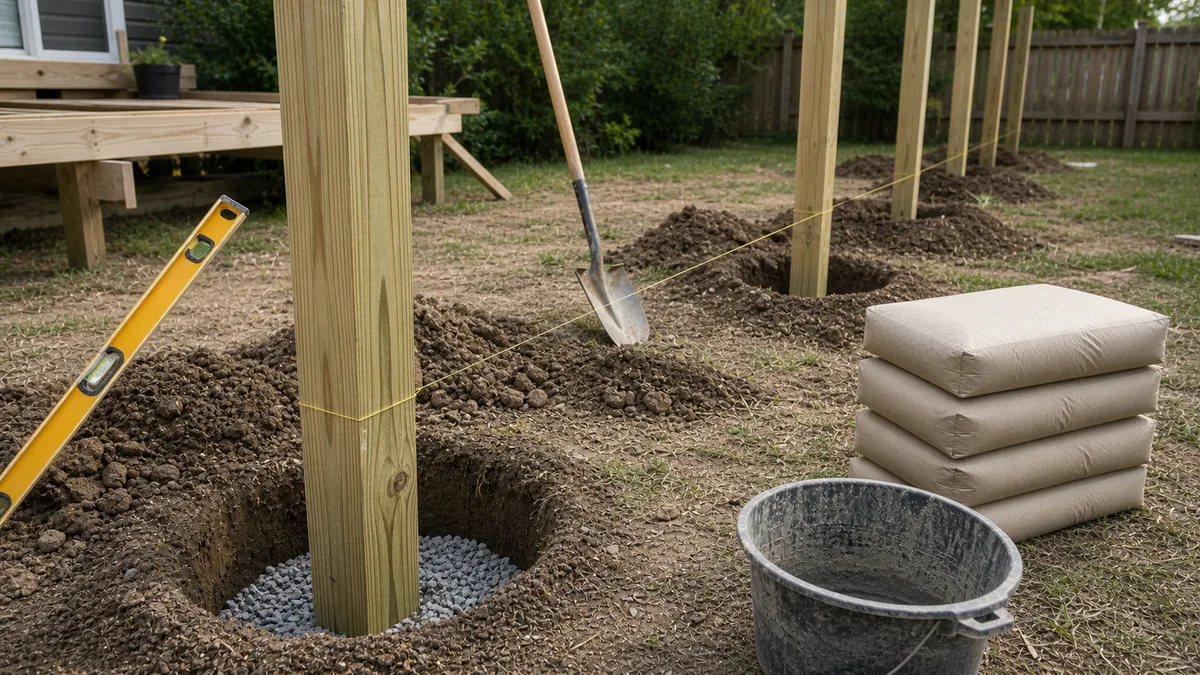
Three field details that decide whether the posts last 30 years or 5. Drainage first — drop 4″ of #57 gravel in the bottom before the post; concrete cradling end-grain in mud is the #1 cause of wood-post rot (IRC R317 calls for ground-contact treated lumber, but the gravel buys you another decade). Crown the top — finish the concrete with a 1″ dome sloped away from the post so water sheets off rather than pooling at the collar. Frost depth — structural deck posts must be poured below the local frost line (IRC Table R301.2(1): 12″ in the Gulf, 42″ in northern New England, 48″ in Minnesota) or they will heave and lift the beam off the post. Typical 2025 USA bag prices run $5–7 for 80 lb Quikrete; fast-setting bags (Q1L / SikaPost Fix) are $7–9 but skip the mixing and set in 20–40 minutes. The single most common estimator mistake on this trade: forgetting to subtract the post volume, which over-orders by 15–30% on wide posts in tight holes.
Related calculators
Setting posts is one step in a larger site build. For a flatwork pour use the concrete driveway calculator, and for hardscape compare a paver patio with bedding sand and base. Spoil from augering ties into the excavation volume calculator and cut and fill calculator; size compacted backfill or post-base gravel with the gravel aggregate calculator.
Calculation notesWhat this calculator doesOpen the formula basis, references and assumptions when you need to verify the detailed method.Review details
Annular hole volume around each post is converted to total concrete and whole bag counts with waste allowance.
Reference context
- • geometric quantity relationships
- • supplier density and coverage data
- • local installation requirements
Important assumptions
- • Dimensions, quantities and prices entered by the user are correct.
- • Waste, laps, overlaps, compaction and delivery allowances must match the actual project.
- • Results are preliminary takeoff estimates, not a sealed structural design or permit approval.
Quality notes updated: August 1, 2026. The repository includes per-page checks for browser errors, populated results, metadata, US-market visibility, duplicate IDs and shared quality controls.
Reference names describe the applicable design and product context; they do not replace a project-specific code review. Local codes, drawings, specifications and manufacturer instructions govern the final work. Report a calculation or interface issue.
