Post Hole Concrete Calculator — m, kg bags, cost
How to use this calculator
Pick a preset for your job, or set post size, hole diameter, depth and post count manually. The tool subtracts the embedded post from a cylindrical hole and rounds bags up per hole — you buy whole bags, not partial. Bag size (20 / 25 / 50 kg) drives the per-hole count.
Post size — common metric posts are 90×90 mm and 140×140 mm.
Hole diameter — roughly 3× the post width is the rule of thumb for lateral bearing.
Depth — one third of the post above ground, with footings below frost line for structural posts.
Saved Calculations
| Time | Posts | Hole | Bags/Hole | Total Bags | Cost |
|---|
How to Calculate Concrete for Post Holes (Metric)
Set post size, hole diameter, hole depth and post count. The tool computes the cylindrical hole volume, subtracts the embedded post volume (square or round), adds your waste allowance, then rounds up to whole bags per hole — bags are bought whole, so each hole is ceiled independently before multiplying by the post count.
How to use it
Use the 1/3 rule for embedment depth: bury roughly one third of the total post length, with a 600 mm minimum for fence posts and footings carried below the local frost line for structural or deck posts. Hole diameter should be at least 3× the post width for adequate lateral bearing. A 10% waste allowance covers spillage, over-augered holes and bell-shaped bottoms; tighten to 5% on clean drilled holes.
Formulas Used
Hole volume: V = π × (diameter/2)² × depth
Square post volume: V = side² × depth
Round post volume: V = π × (diameter/2)² × depth
Concrete per hole: (hole volume − post volume) × (1 + waste)
Bags per hole: ceil(concrete per hole ÷ bag yield)
Bag Yields
25 kg bag ≈ 0.012 m³ (12 liters), 50 kg bag ≈ 0.024 m³ (24 liters), 20 kg bag ≈ 0.010 m³ (10 liters). Standard premixed concrete yields used consistently across the site. Cost is a flat per-bag price × total bags, with a currency selector.
FAQ
How deep should a post hole be? General rule: 1/3 of total post length underground, minimum 600 mm for fence posts, footings below the frost line for structural posts per local building codes.
How wide should the hole be? Approximately 3× the post width. For a 90×90 mm post, use a 250–300 mm diameter hole.
Do I need to deduct the post volume? Yes — the post displaces concrete, so net fill is hole minus post. Skipping this over-orders by 15–30% on wide posts in tight holes.
On install day
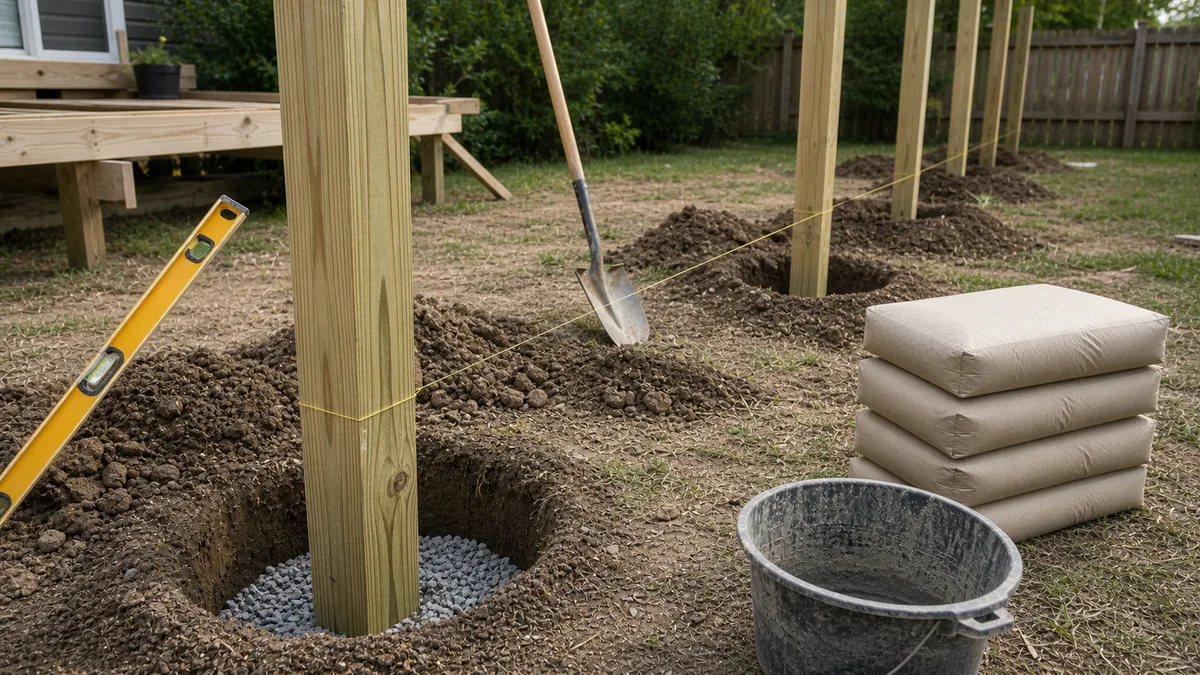
Three field details that decide whether the posts last 30 years or 5. Drainage first — drop 100 mm of crushed stone (0/32 or 4/32) in the bottom before the post; concrete cradling end-grain in mud is the #1 cause of wood-post rot. Crown the top — finish the concrete with a 25 mm dome sloped away from the post so water sheets off rather than pooling at the collar. Frost depth — structural deck posts must be founded below the local frost line (EN 1997 / national annex: 600 mm typical for Western Europe, 800–1200 mm in Scandinavia and continental winters) or they will heave and lift the beam off the post. Typical 2025 EU bag prices run €4–6 for 25 kg standard mix; fast-setting bags (Sika PostFix, Quikrete Q1L) cost €6–9 but skip the mixing and set in 20–40 minutes. The single most common estimator mistake on this trade: forgetting to subtract the post volume, which over-orders by 15–30% on wide posts in tight holes.
Related calculators
Setting posts is one step in a larger site build. For a flatwork pour use the concrete driveway calculator, and for hardscape compare a paver patio with bedding sand and base. Spoil from augering ties into the excavation volume calculator and cut and fill calculator; size compacted backfill or post-base gravel with the gravel aggregate calculator.
